
Benjamin J. Harbert
Professor of Music and Chair of the Department of Performing Arts at Georgetown University (USA)
The City as Sound: Experimental Techniques in the Contemporary City Symphony
The city symphony film, with classics like Berlin: Symphony of a Great City (1927) and Man with a Movie Camera (1929), initially celebrated the grandeur of urban life and then seemed to cede to narrative films and documentaries by the mid-century. This talk argues for a revival of the genre with an expanded definition of the city symphony, demonstrating its continued relevance as a critical and evolving tool for examining the complex relationship between the body, technology, and the urban landscape. While classic works captured the city’s visual rhythm, subsequent films explore urban social and political tensions (like Do the Right Thing), use experimental forms to address the technological age (Koyaanisqatsi), and embrace fragmented narratives (Symbiopsychotaxiplasm). This expanded definition ensures that the city symphony remains timely, offering urgent insights into the changing nature of cities and our place within them using musical structures to offer critical perspectives. As urban life rapidly transforms, keeping this genre alive provides a way to feel, understand, and question the trajectory of our future cities.
 Benjamin J. Harbert, Professor of Music and Chair of the Department of Performing Arts at Georgetown University, examines the relationships between music and social institutions through his award-winning scholarship on prison music, documentary film, and American cultural history. He is the author of Instrument of the State: A Century of Music in Louisiana’s Angola Prison (Oxford University Press, 2023), which received the Music in American Culture Award from the American Musicological Society and the Portia K. Maultsby Prize from the Society for Ethnomusicology. He is also the author of American Music Documentary: Five Case Studies of Ciné-Ethnomusicology (Wesleyan University Press, 2018) and the director of Follow Me Down: Portraits of Louisiana Prison Musicians (Films for the Humanities & Sciences, 2013). He is the co-founder and co-editor-in-chief of the Journal of Audiovisual Ethnomusicology, editor of a special issue of American Music on Women’s Prison Music (2013), and co-editor of The Arab Avant-Garde: Music, Politics, Modernity (Wesleyan University Press, 2013). His research has evolved from examining music in state prison systems to investigating soundscapes in Washington DC’s jail system, where he also taught through Georgetown’s Prisons and Justice Initiative. Harbert has been a teaching fellow at the University of California, Los Angeles, a lecturer at Pomona College, and a resident artist at the Performing Arts Center of Los Angeles County. Before returning to academia, he directed the guitar, percussion, and music theory programs at Chicago’s Old Town School of Folk Music. He has performed guitar, tabla, and ‘ud at venues that range from Carnegie Hall and the Kennedy Center to the Empty Bottle and Spaceland. At Georgetown, he teaches ethnomusicology, documentary film, and American music courses while regularly bringing prominent musicians and filmmakers to campus, including Wayne Kramer, Ian MacKaye, Charles Neville, Will Oldham, Jill Godmillow, and Albert Maysles.
Liu Guiteng (刘桂腾)
Shanghai Conservatory of Music (China)
Interperspectivity and the Emergence of the “Neo-Others”: A Case Study of Audiovisual Documentation of Qiang and Yi Belief-Based Intangible Cultural Heritage (ICH)
The dramatic transformation of contemporary fieldwork relationships has posed significant challenges to the preservation and transmission of traditional Chinese culture, while also presenting urgent methodological dilemmas for ethnomusicological ethnography and audiovisual discourse construction. A notable phenomenon in this context is the emergence of the “Neo-Others”.This paper employs two belief-based Intangible Cultural Heritage (ICH) audiovisual documentation case studies by ethnomusicologist Liu Guiteng as primary exemplars: On the Clouds: A DV Narrative of Qiang Shibi Investigation (Gong Daoyuan, cinematographer; Puxi, Aba Tibetan and Qiang Autonomous Prefecture, 2018) and Shi Tou Ji: An “Insider” Interpretation of Liangshan Yi Suni by a Neo-Others (Wang Yifan & Jiang Yu, cinematographers; Zhaojue, Liangshan Yi Autonomous Prefecture, 2024). Proceeding from an academic stance that respects and acknowledges the cultural interpretative authority of local elites, this study discusses participation and observation method in ethnomusicology and visual narrative strategies in ethnographic filmmaking. Building upon “Rouch’s Question” as an analytical entry point, it explores strategies for constructing audiovisual ethnographic text focused on the “Neo-Others” through transforming unidirectional catalyst (interview) techniques into bidirectional interperspective (dialogue) approaches within fieldwork praxis.
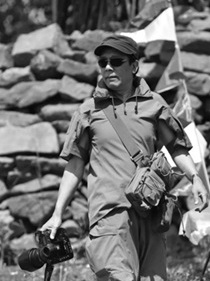 Liu Guiteng is a inviting Professor at the Shanghai Conservatory of Music and Vice President of the Chinese Traditional Music Society. His main research fields include Shamanic music, Manchu music and theories & methods of ethnographic film of music. He has led multiple national research projects, including those under China’s 8th, 9th, and 10th Five-Year Plans for Arts and Sciences, as well as sub-projects of the Major Research Projects in Philosophy and Social Sciences supported by the Ministry of Education. He has also collaborated on research initiatives with the Central Conservatory of Music, Shanghai Conservatory of Music, and China Conservatory of Music. His scholarly contributions include influential works like A Study of Shaman Drum Music, Research on Manchu Shaman Musical Instruments, Manchu Music Research (co-authored), The Musical Culture of Chinese Shamanism, An Illustrated Guide to Chinese Shaman Musical Instruments, and Lectures on ethnographic film of music. Additionally, he has produced significant ethnographic documentaries, such as Spring Sacrificial Ritual of the Manchu Hala Clan’s Shamanism, The Lhashze Ritual, The Jumping Bozha Ritual, and Field Notes on the Yi “Nimu Cuobi” Ritual in Liangshan, showcasing his deep engagement with traditional music and ritual practices.
Richard K. Wolf
Professor of Music and South Asian Studies at Harvard University (USA)
Ethnographic Filmmaking as Art, Science, and Social Act: An Ethnomusicologist’s Perspective
Dai Vaughan, the influential documentary editor and writer, once defined “documentary” as “mode of response to film material . . . in which the image is perceived as signifying what it appears to record” (1999, 48). Visual anthropologist and filmmaker Jay Ruby, in differentiating among the many films claiming to document something, reserved the term “ethnographic” for films made by trained ethnographers and meant to convey anthropological knowledge. In doing so, he also noted anthropologists’ longtime recognition of artists as “trained observers” with “significant insights into human behavior” (2000, 63). Ethnomusicologist-filmmakers, as artists, may also have access to such insights.
Although many ethnomusicologists have had training and experience as artists—in composition, creative writing, sound art and film—many other ethnomusicologists are nonplussed by the creative work—worried that it is somehow less true to reality, less reliable, less intellectual, and less serious as work, as compared with conventional genres of academic writing.
As an ethnomusicologist I’ve encountered skepticism around my own creative experimentation. Writing in a creative mode is not just making things up. I’ve used my writing to set up evidence-based, plausible scenarios that allow the reader to approach a subject from more than one angle. Ethnomusicological filmmaking as artistic practice too holds emotive as well as denotative possibilities well beyond merely those of illustrating a book’s musical examples on a companion website.
A confusion persists inside and beyond our field about music’s value as an aesthetic object, and the value of what can be said or filmed about it—as if the merit of the book or film lies in the (culturally biased) aesthetic merit of the musical object. For me, an ethnomusicological film places music and sound on equal footing with other kinds of (mainly) human activities in a given cultural-historical moment. It should do something: carry a message, make an argument, tell a story, pose questions about its subject; it should leave room for viewers to insert themselves—to take away different possible messages. Viewed externally, so-called ethnomusicological films may seem merely to “celebrate the rich heritage of music and sound,” as the RAI (Royal Anthropological Institute) film festival put it in 2023. In contrast, films up for RAI’s Richard Werbner award are supposed to be “made by an academic anthropologist” and “based upon extensive fieldwork by the film-maker among the film’s subjects.” RAI’s rubrics that year set up false dichotomies, clearly.
In this keynote lecture, I will reflect on two of my films that grew out of long-term fieldwork, one along the border of Tajikistan and Afghanistan (10 years), and the other in the Nilgiri Hills of South India (35 years). I will focus on my artistic and musically trained moves as an editor and fieldworker, the narrativity of the films as films, the value of documenting others speaking to one another in their own language, and the act of filmmaking as a necessarily social one.
 Richard K. Wolf, Professor of Music and South Asian Studies at Harvard University, has been conducting ethnomusicological research in South and Central Asia for four decades. Author of two monographs and editor of three collections, Wolf has published on such topics as social-cultural “style” in South Indian classical music, conceptions of space, time and music among the Kota tribal people in the Nilgiri Hills of south India, and drumming, “recitation,” and music in public Islamic contexts in India and Pakistan. Wolf’s current projects include a monograph on poet-singers entitled The Nightingale’s Despair: Music and Moral Being in Greater Central Asia and a co-edited volume entitled Musical Thinking: Poetry, Improvisation and Theory (Oxford University Press). As an ethnographic filmmaker, Wolf spent ten years making Two Poets and a River (Documentary Educational Resources), a film focusing on the poetry, music, and lives of two Wakhi poets living on opposite sides of the river that divides Tajikistan and Afghanistan. He is currently working on a series of films, entitled Pots of Millet, Faces of Gold, concerning transformations in the indigenous Kota community of South India over the past century. He holds a 2023 article prize from the International Council for Traditions of Music and Dance for, “The musical poetry of endangered languages: Kota and Wakhi Poem-Songs in South and Central Asia” (Oral Tradition 35). From 2012-2018 Wolf held a Friedrich Wilhelm Bessel Research Award from the Alexander von Humboldt Foundation. During the 2018-2019 academic year he was the Carl and Lily Pforzheimer Foundation Fellow at the National Humanities Center in Research Triangle Park, North Carolina. His most recent book-length publication is Thought and Play in Musical Rhythm (OUP 2019), a volume he coedited with Stephen Blum and Christopher Hasty. Wolf is also a writer of creative non-fiction and a performer on the South Indian vina.
 Audiovisual Ethnomusicology