
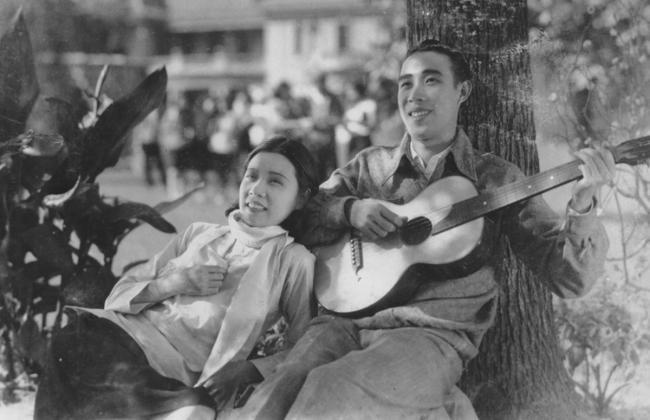
Actor, director, film theorist, star of Shanghai’s golden age, victim of the Cultural Revolution: Zheng Junli led a life as remarkable as any fictional character’s. Born to a poor family in Shanghai in 1911, Zheng became one of Chinese cinema’s biggest silent-era stars. His high cheekbones and floppy hair projected a debonair charm, yet his appeal was grounded in his frequent roles as a fighter for justice and anti-imperialist action.
The Second Sino-Japanese War found Zheng moving behind the camera, filming several remarkable news documentaries. After World War II, he returned to Shanghai, codirecting the classic Spring River Flows East. As China transitioned not-so-peacefully into the era of Mao Zedong and the People’s Republic, Zheng rode the various waves of change to create some of the era’s most intriguing blends of melodrama, art, and politics, each fueled by an innovative merging of Chinese art history with film form. He also published several volumes of film theory.
Like many artists in the Mao era, though, Zheng would be praised during one political moment and damned during another. Swept up in the Red Guard furor of the mid-1960s, his entire career was slandered as counterrevolutionary. He was arrested in 1967, and died in prison in 1969, at age 57.
 Audiovisual Ethnomusicology